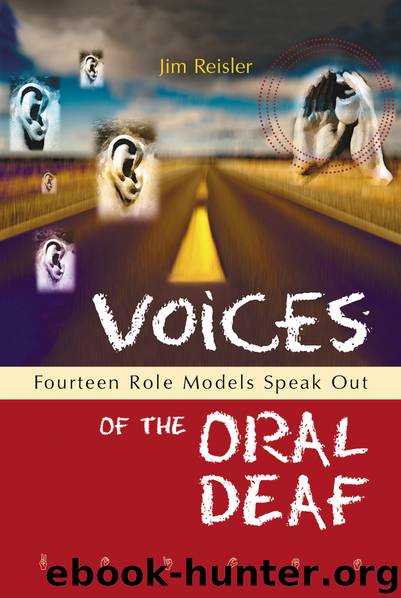
Voices of the Oral Deaf by Jim Reisler
Author:Jim Reisler
Language: eng
Format: epub
Publisher: McFarland
Published: 2016-09-09T04:00:00+00:00
Karen Kirby with Cinder
At the same time, I have to admit that one of the reasons I didn’t want to get another hearing dog is because I grew so attached to them. I have another dog, a pet, but I still haven’t gotten a new working dog.
Like a lot of oral deaf people, I didn’t learn to sign until I was an adult. It wasn’t until after the A.G. Bell Convention in 1980 when I learned. I remember it well: I had gone out with a bunch of people and had some problems hearing some of these people or even lipreading because the restaurant was so dark.
When the restaurant manager came by and started signing with one of the people at the table, I was able to see it from the perspective of how my companions felt as deaf people. It helps them communicate. You have to remember I had enough hearing—and still have enough hearing—that I can generally get by without signing.
These people were oral, but they also signed. I didn’t know at the time that they knew sign or that they were majoring in deaf education. And I kept asking, “What are you saying?” and “What are you all signing?” I got lost.
So, I decided to learn. I wanted to know what they were saying. Over the years, I found that it’s just another language. I figured if I wanted to be an effective counselor, I needed to be able to communicate with people who sign.
But even today—on the job—I’m still not exposed to a lot of deaf people. For the most part, the deaf people I see at work come to my office because they know I can communicate with them. They generally sign and mouth the words. I sign in English, whereas they sign in American SignLanguage or ASL. But they’ll move their mouths, since I can understand lip-reading and some sign. I ask them to move their mouths and to sign at the same time to help me improve my respective skills. So we sign and communicate.
That speaks to a larger point: You need to learn to read and write in spoken language. ASL is not using English. When you pick up a book, it’s in English. You can’t write a letter in ASL.
I believe if you’re deaf, it’s a real advantage to learn signing after you learn to speak. Looking back, I wish I’d had the advantage of using interpreters. Deaf students today are fortunate to have this as an option.
People have choices. Over the years, I’ve met some deaf people who see that I can speak and so they say to me, “Oh, you’re hearing.” But I’m not. I’m deaf. There’s no exact definition of the word “deaf,” or the term “hard of hearing.”
So why get involved in community activities? At college, people said I couldn’t succeed. Today, deaf people are insisting they can. The people who said I could is the reason I’m involved in the A.G. Bell Association. Being able to
Download
This site does not store any files on its server. We only index and link to content provided by other sites. Please contact the content providers to delete copyright contents if any and email us, we'll remove relevant links or contents immediately.
| Anthropology | Archaeology |
| Philosophy | Politics & Government |
| Social Sciences | Sociology |
| Women's Studies |
Cecilia; Or, Memoirs of an Heiress — Volume 1 by Fanny Burney(32561)
The Great Music City by Andrea Baker(32021)
Cecilia; Or, Memoirs of an Heiress — Volume 2 by Fanny Burney(31958)
Cecilia; Or, Memoirs of an Heiress — Volume 3 by Fanny Burney(31944)
We're Going to Need More Wine by Gabrielle Union(19051)
All the Missing Girls by Megan Miranda(16042)
Pimp by Iceberg Slim(14517)
For the Love of Europe by Rick Steves(14154)
Bombshells: Glamour Girls of a Lifetime by Sullivan Steve(14079)
Talking to Strangers by Malcolm Gladwell(13375)
Norse Mythology by Gaiman Neil(13372)
Fifty Shades Freed by E L James(13245)
Mindhunter: Inside the FBI's Elite Serial Crime Unit by John E. Douglas & Mark Olshaker(9346)
Crazy Rich Asians by Kevin Kwan(9295)
The Lost Art of Listening by Michael P. Nichols(7507)
Enlightenment Now: The Case for Reason, Science, Humanism, and Progress by Steven Pinker(7315)
The Four Agreements by Don Miguel Ruiz(6767)
Bad Blood by John Carreyrou(6625)
Weapons of Math Destruction by Cathy O'Neil(6283)
